Journal
Wardrobe Color for Camera: Separate the Person from the Set
Choose wardrobe with camera tests for background separation, skin, texture, movement and continuity instead of judging outfits in isolation.
Refsee ·
Wardrobe communicates character, but it also occupies a large and moving area of the image. A costume can blend into a wall, reflect colored light onto a face or produce distracting fine patterns. Choosing clothing for camera means testing it as part of the scene rather than as an isolated outfit.
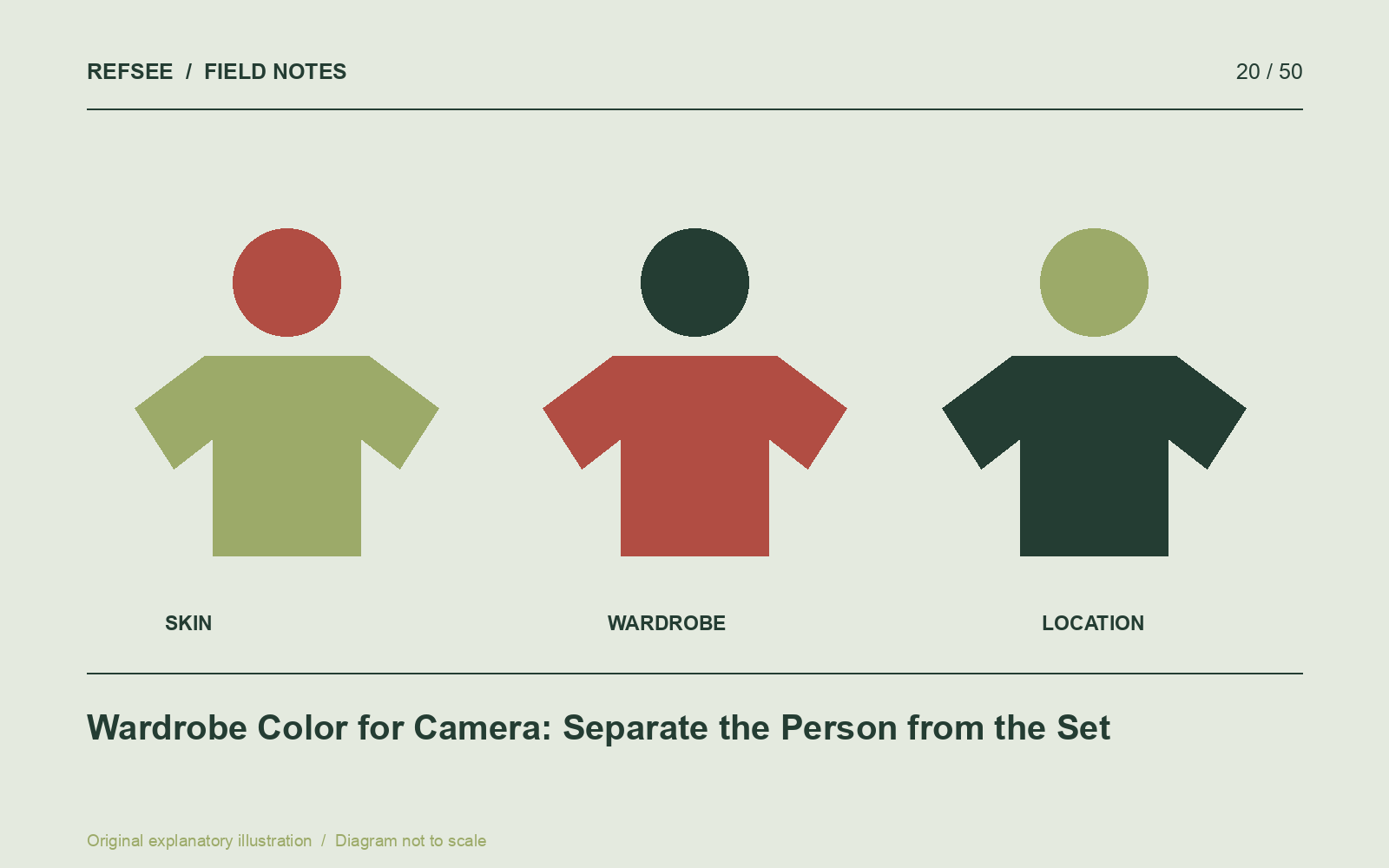
Start with the character and the location
Write a short description of what the clothing should communicate. A person dressing to impress may choose differently from someone trying to disappear. Then compare that intention with the location's dominant colors and materials.
Bring fabric samples or quick photographs to the scout. A dark green jacket may separate beautifully from pale concrete and vanish against a similarly valued green wall. Hue difference alone is not enough; check a black-and-white preview to assess brightness separation.
Test under the intended light
Record the actual garment with the person or a stand-in. Include close and wide shots. White fabrics can become the brightest region in a scene, while deep black fabrics may lose detail depending on exposure and lighting. Neither is inherently wrong, but the effect should be intentional.
Fine stripes, tight checks and some textured weaves can interact with the camera's sampling to produce moiré or aliasing. Test the recording format and likely framing distance. A pattern that behaves well in a phone snapshot may not behave the same way in the production camera.
Watch movement and sound
Ask the performer to carry out the planned action. Check whether the garment restricts motion, changes shape unexpectedly or hides important hand gestures. Listen for fabric noise around a lavalier microphone and coordinate adjustments with sound.
Consider how accessories catch light. A watch, necklace or glossy button can produce an intermittent highlight during dialogue. Those small changes may attract attention more strongly than a static wardrobe photograph suggests.
Document the whole look
Photograph layers, cuffs, collars, jewelry and shoe choices. Record whether sleeves are rolled, shirts are tucked and jackets are fastened. These details matter when scenes are filmed out of order.
Keep an alternate garment available when possible, chosen for a specific problem rather than as a random backup. A useful alternative might be one value lighter, less reflective or free of fine pattern. The best wardrobe decision supports performance, character and image clarity at the same time.