Journal
Production Design on a Small Budget: Change What the Camera Sees
Prioritize low-budget production design through framing, surfaces, meaningful props and continuity rather than decorating every part of a location.
Refsee ·
Production design creates the physical world of a film. On a small budget, the most useful question is not “How do we decorate this whole room?” but “What must this frame tell us about the person who lives here?” Framing and story relevance let a few deliberate changes carry substantial meaning.
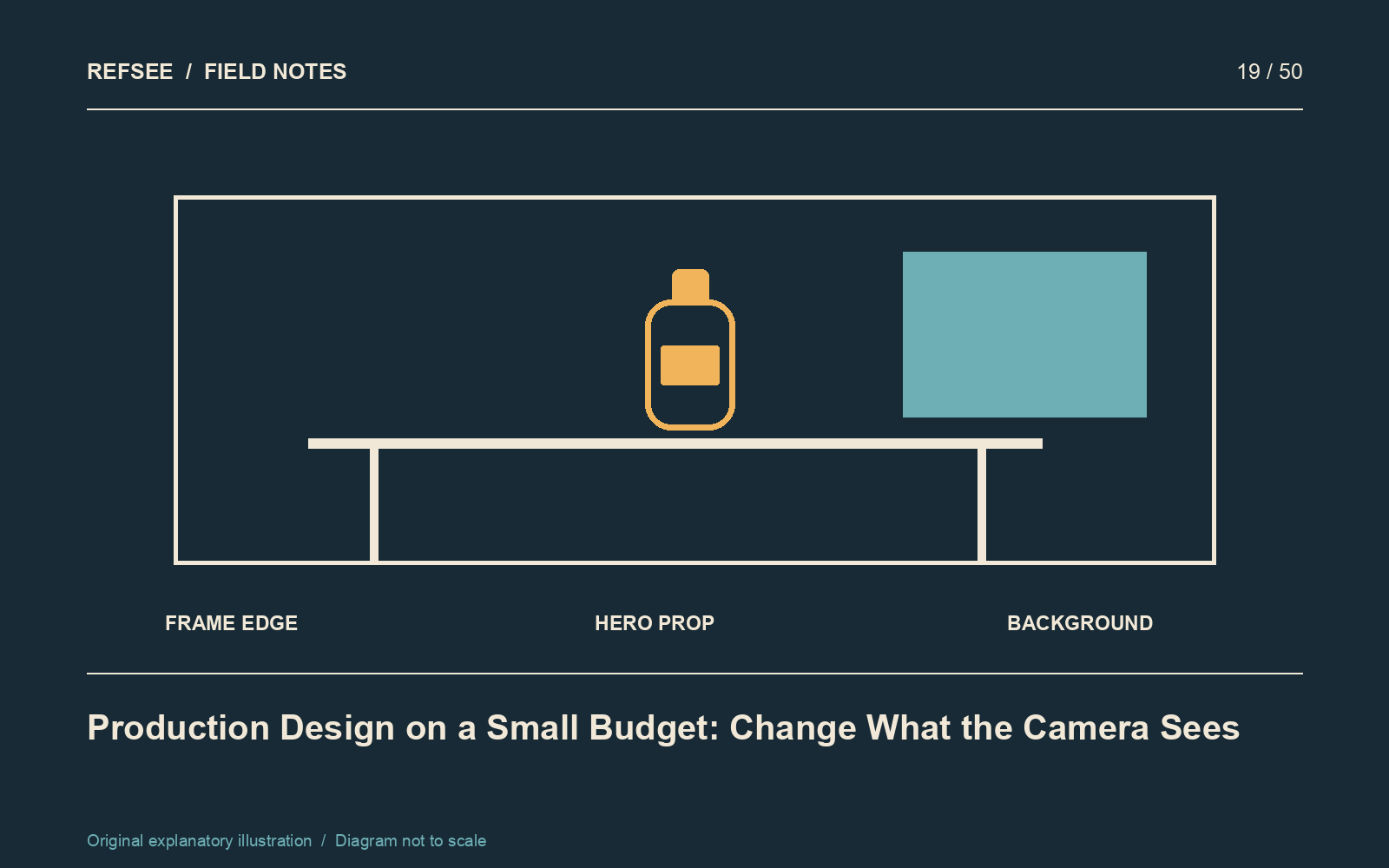
Begin with character evidence
List what the space should reveal: profession, habits, resources, recent activity or a change in the character's life. Choose details that can be seen at the intended shot size. A carefully written letter is wasted as background decoration if the camera never gets close enough to read it.
For a character who repairs things, worn tools and a half-finished object may say more than a wall of unrelated vintage posters. Let the environment suggest use rather than a shopping list of “interesting” props.
Lock the camera before dressing everything
Scout likely angles and identify the visible surfaces. A distracting wall, unsuitable chair or bright appliance may deserve attention before any additional decoration. Removing or repositioning an object is often more effective than adding another.
Concentrate on the background immediately around the performer. It affects silhouette, color separation and the impression of the room. Then consider foreground elements and any surfaces touched during the action.
Repeat a small material language
Choose a few compatible materials, colors and wear patterns. An inexpensive room can feel coherent when wood tones, fabrics and objects appear to belong to the same life. Artificially aging every item in the same way can be less convincing than leaving some objects newer than others.
Test reflective surfaces under the lighting. A glossy picture frame or metal appliance may reveal equipment or create a highlight stronger than the actor. Matte alternatives or a slight angle change can solve the problem without a major purchase.
Protect continuity and practical use
Photograph the set before shooting and after any significant action. Record positions of hero props, open drawers, liquid levels and objects moved by performers. Keep duplicates or a reset plan for items that are consumed or damaged in the scene.
Finally, walk through the space with the actor. Can they sit, reach, open and move naturally? A set should support behavior. The most convincing low-budget design often comes from a few well-chosen objects that performers can genuinely use.