Journal
How to Analyze a Film Still and Find a Useful Reference
Analyze a film still through attention, framing, light, color and implied movement, then turn observations into practical decisions for your own project.
Refsee ·
A film still can be a rich reference, but “I like this frame” is only the start of the analysis. To use it well, separate the visible decisions that create the effect. Ask what attracts attention first, how the subjects relate to the space and which parts of the image could be translated into your own production.
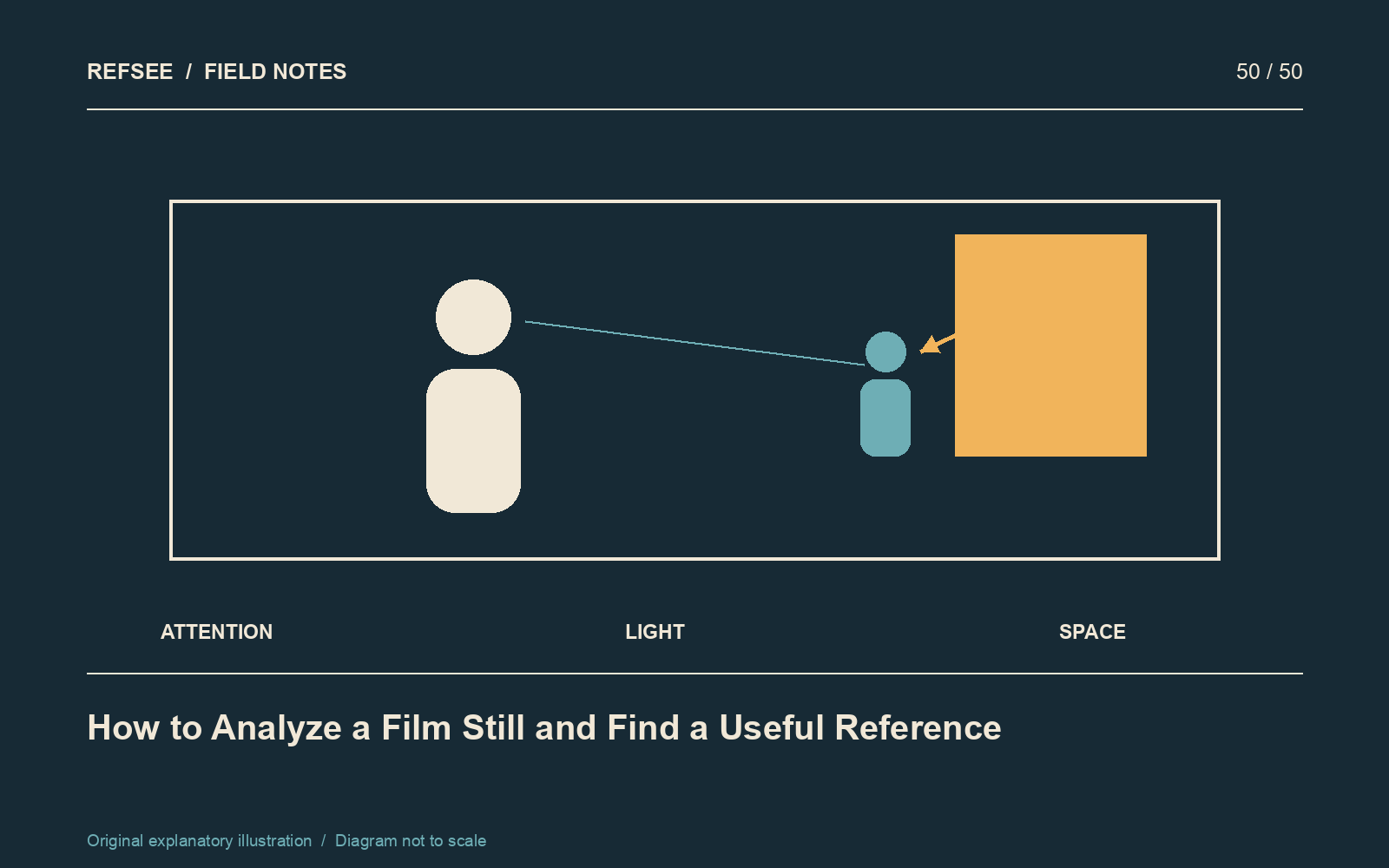
Describe before interpreting
Write a neutral description: two people, one near the camera, one beside a window, a dark wall between them. Then describe the hierarchy: the window-side face is brightest, the foreground figure is larger, and the empty wall separates them.
Only afterward add interpretation. The arrangement may suggest distance or unequal knowledge, but a still alone does not prove the filmmaker's intention. Distinguish what you can observe from what you infer.
Examine the frame in layers
Look at shot scale, camera height, viewpoint, overlap and negative space. Trace the strongest lines and note where they direct the eye. Check whether the frame relies on symmetry, imbalance or a foreground obstruction.
Then examine light direction, softness and contrast. Identify visible or implied sources without pretending to know the exact fixtures used. A still can suggest a large side source; it usually cannot tell you the lamp model or its precise distance.
Separate color from brightness
Identify dominant colors and small accents, then inspect a monochrome version if available. Does the subject separate because of hue, value, focus or several cues together? That distinction affects how you might reproduce the relationship in another location.
Consider wardrobe, surfaces and reflections alongside grading. A finished palette is the result of many departments. Copying a color treatment will not recreate a frame whose impact depends on architecture or blocking.
Return to the moving scene
If you can access the source, watch what happens before and after the still. The camera may be moving, a character may be crossing the frame or the composition may last only a fraction of a second. Record the timestamp and describe the shot's development.
Finish with one transferable instruction, such as “keep the nearer figure dark while the distant face carries the information.” Search for contrasting examples in Refsee to test whether that principle survives different subjects and settings. A useful reference is an explanation of a visual decision, not just an image you hope to imitate.