Journal
Focal Length vs. Camera Distance: What Changes Perspective?
Understand how camera distance changes perspective and how focal length changes framing, with a simple portrait test you can repeat yourself.
Refsee ·
Focal length and camera distance are often discussed as though they do the same thing. They do not. From a fixed camera position, focal length changes angle of view and image magnification. Perspective—the apparent size relationships between objects at different distances—is determined by viewpoint. The confusion arises because photographers usually move when changing lenses to preserve the framing.
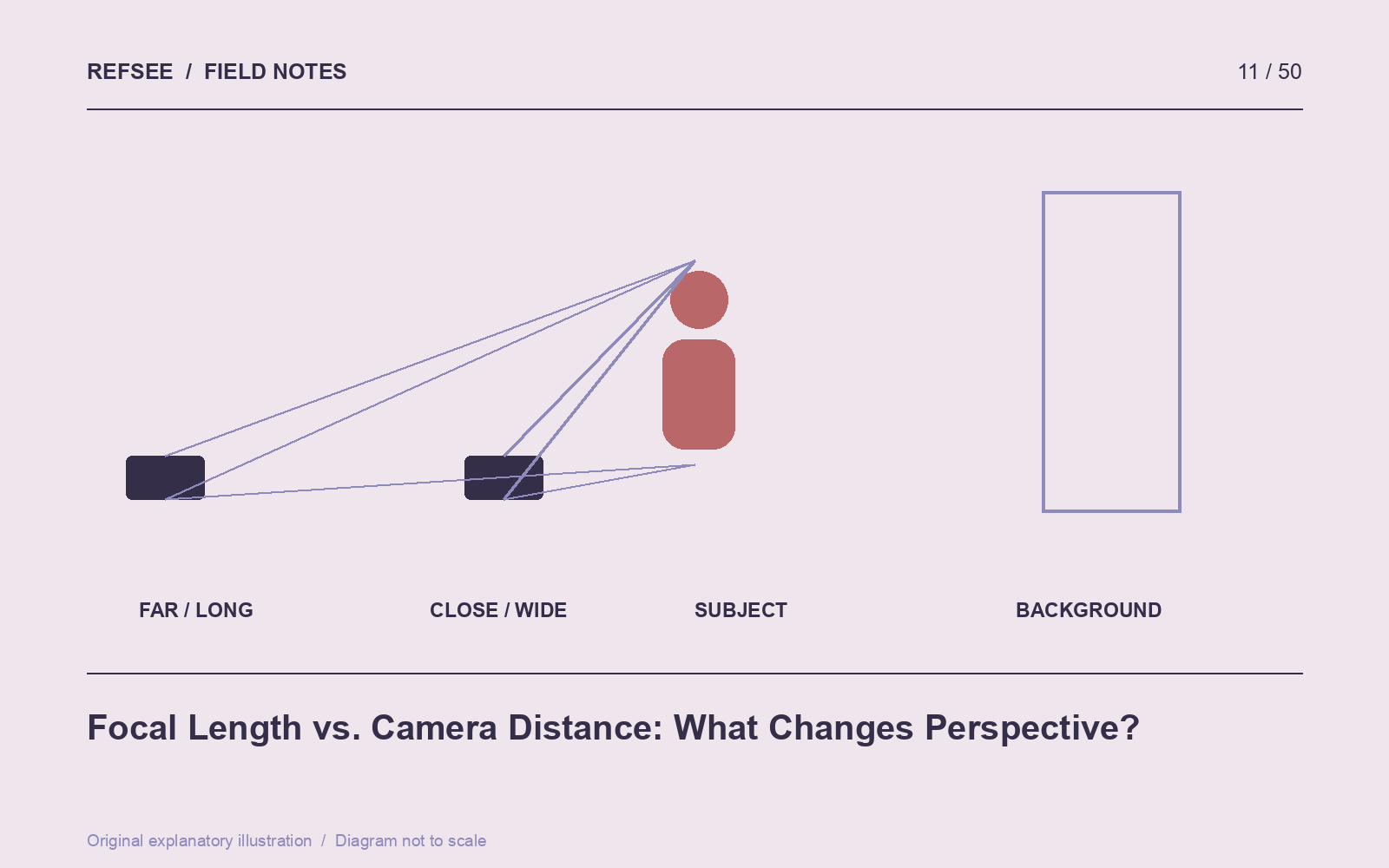
Separate two different comparisons
First, put the camera on a tripod and photograph a person with a short and a longer focal length without moving. The longer lens gives a tighter view. If you crop the wider image to the same field of view, the perspective relationships will be essentially the same, allowing for lens distortion and other optical differences.
Next, move the camera to keep the person's head approximately the same size with each lens. Now the perspective changes. The close viewpoint emphasizes differences in distance between the nose, ears and background. The farther viewpoint makes those differences less pronounced.
Understand the compressed-background effect
When a distant background appears large behind a portrait taken with a long lens, the shooting distance is a key part of the result. The camera has moved farther from the person to maintain their size in the frame. The ratio between camera-to-subject and camera-to-background distances has changed.
This is why “use a long lens for compression” is a useful shorthand but an incomplete explanation. It can lead you astray in a small room where you cannot move back.
Choose the relationship before the number
For an intimate, energetic portrait, a closer viewpoint may be appropriate. For a calmer image with less pronounced near-to-far variation, work farther away. Then choose the focal length that gives the framing you want on your sensor format.
Account for background visibility and depth of field as separate decisions. Aperture, focus distance, focal length, sensor format and final viewing conditions all influence the perceived result. A focal-length label alone does not specify the look.
Make a reference sheet
Photograph the same subject at three distances with similar framing. Keep the background and lighting fixed. Label the images with distance, focal length and sensor format. Include a foreground object if you want the perspective change to be especially clear.
Use this sheet when discussing references with collaborators. “I want the viewpoint of the close version, but more room around the subject” is a much more precise instruction than “make it more wide-angle.”