Journal
Architectural Photography: Control Vertical Lines and Viewpoint
Photograph architecture with intentional verticals, useful camera height and coherent spatial relationships, with less reliance on perspective correction.
Refsee ·
Architectural photography translates a three-dimensional building into a two-dimensional image. Viewpoint determines which planes overlap, how the entrance reads and whether the building feels grounded. Vertical lines are important, but making every line perfectly parallel is not the only goal. The image should explain the architecture and support the intended experience.
Choose the viewpoint before the lens
Walk around the building and compare how the facade, side elevation and surrounding space relate. A small lateral move may separate a column from an entrance or reveal the depth of a courtyard. These changes cannot be recreated by simply cropping later.
Consider camera height. A higher authorized viewpoint may help show a facade without extreme upward tilt. A lower view can emphasize scale, but it may conceal important features or make the foreground disproportionately large.
Understand converging verticals
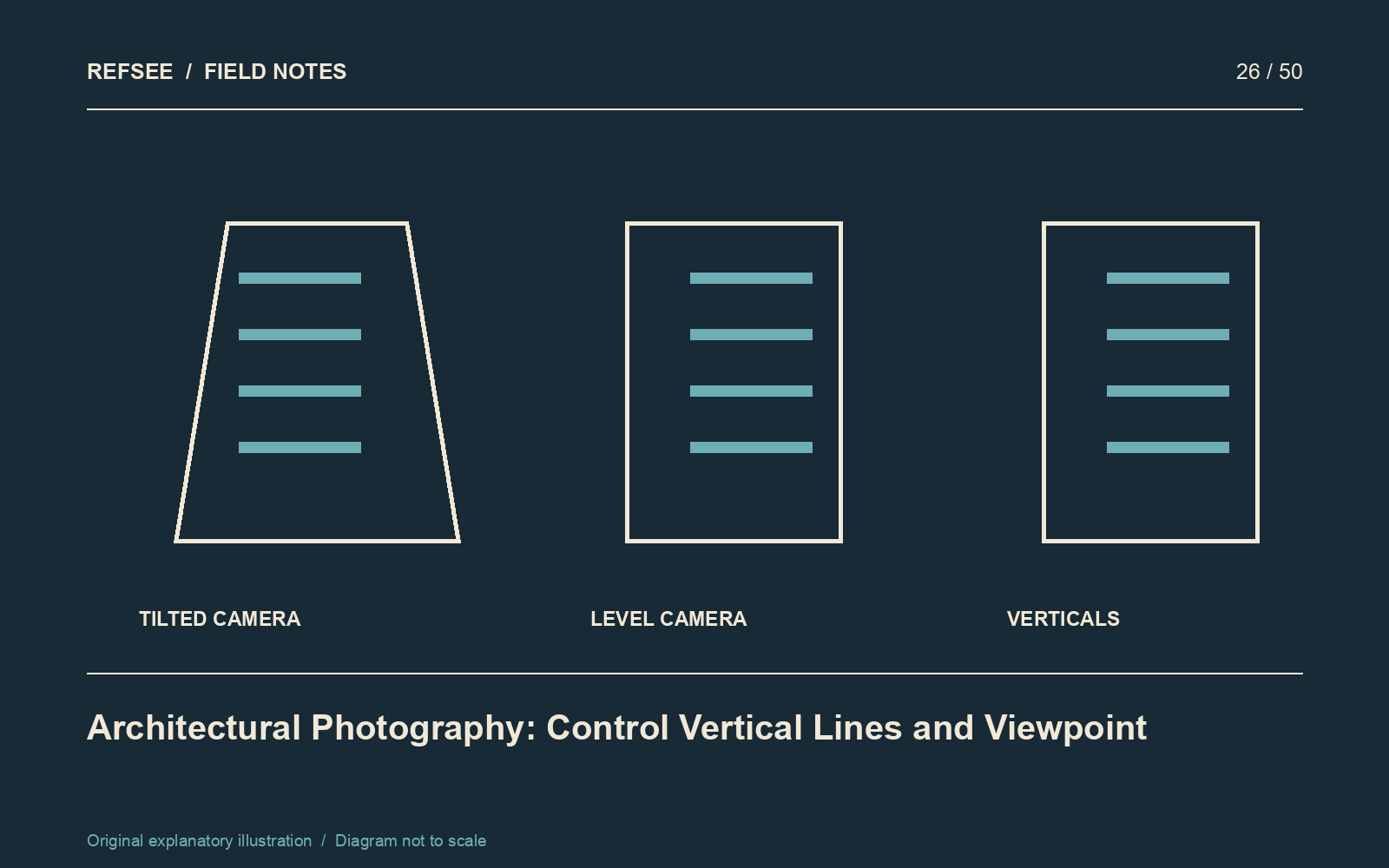
When the camera tilts upward, vertical lines generally converge in the image. Keeping the camera level preserves parallel verticals, but may include too much ground or cut off the top of the building. A shift lens or a different viewpoint can help reframe while maintaining the desired geometry.
Software correction is useful, but it stretches and crops the image. Leave room around the composition and inspect edge quality after correction. Extreme adjustments can create an unnatural impression even when the lines are technically straight.
Time the light for the surfaces
Watch how light describes depth around windows, overhangs and material joints. Front light may reveal color clearly but reduce relief. Side light can emphasize texture and volume. Overcast light may suit a complex facade where hard shadows would hide information.
Record the time and conditions at the scout. Choose the light according to the building's important features rather than assuming sunrise or sunset is always the correct answer.
Include context selectively
A person, tree or neighboring structure can explain scale and use. Check that context does not block the architectural feature the image is meant to show. Avoid removing permanent design elements in retouching when the photograph is intended as a factual record.
Review a small sequence rather than one hero frame alone: context, principal view, spatial connection and material detail. Together, these images can explain a building more accurately than a single ultra-wide view that attempts to include everything.