Journal
How to Choose an Aspect Ratio for Your Film
Compare common film aspect ratios by testing people, locations and delivery formats before committing to a wider or taller composition.
Refsee ·
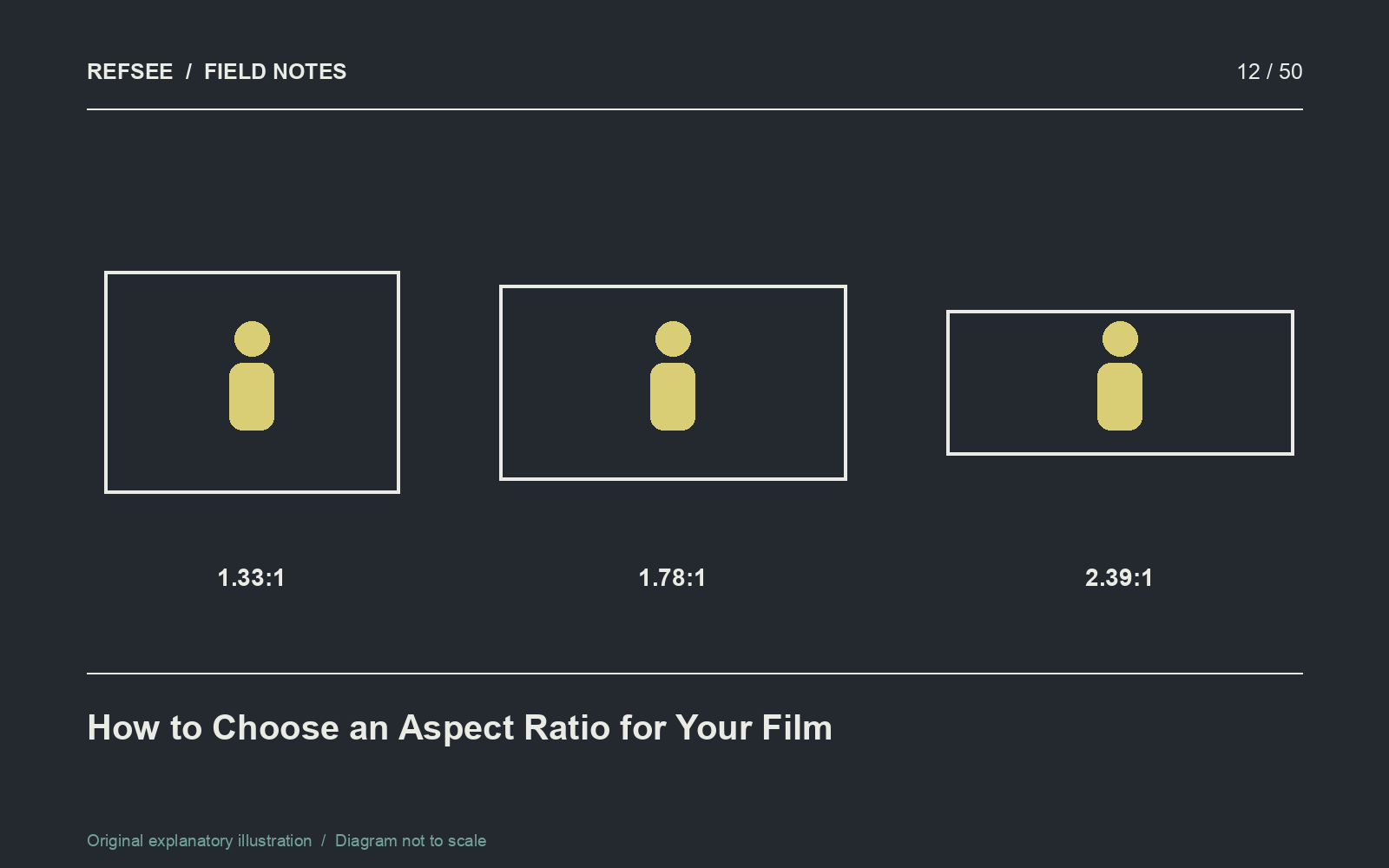
Aspect ratio is the relationship between an image's width and height. It shapes how people, architecture and empty space can coexist in the frame. A wide ratio does not automatically make a film more cinematic, and a nearly square frame is not automatically intimate. The useful question is which shape supports your subjects and where the finished work will be viewed.
Start with the bodies and spaces
Photograph or sketch your most important compositions in several ratios. A scene with two people separated across a room may benefit from width. A standing figure in a narrow stairwell may make stronger use of height. A close portrait changes character when the frame includes more environment beside the face.
Test the difficult shots, not just the hero image. Doorways, full-body movement and crowded groups often reveal practical limitations before a landscape does.
Know the delivery requirement
Confirm the actual destinations and specifications with the distributor, client or platform. A theatrical composition and a vertical social cut have different needs. If multiple formats are required, plan them before shooting rather than hoping that a central crop will preserve every scene.
Use monitor guides for the intended framing. Where possible, record enough image area to allow modest adjustments, but do not treat extra pixels as a substitute for composition. Important relationships can disappear when a wide two-shot becomes a narrow crop.
Design the space around the subject
In a wider frame, horizontal separation and lateral movement can become prominent. In a taller frame, headroom, body language and vertical architecture may matter more. Neither choice requires placing every subject in the center.
Look at how the ratio affects close-ups, not only wide shots. Does empty space support an eyeline or create an unwanted gap? Does a wide frame encourage you to include a second person, or does it dilute a moment that should feel concentrated?
Run a short edit test
Cut a simple sequence in two candidate ratios. Include an establishing shot, a conversation, a close-up and a moving subject. Watch on the devices or screens relevant to delivery. Compare readability, continuity and the amount of reframing required.
Commit once the ratio has proven useful across the sequence. Black bars are a consequence of fitting one image shape inside another display shape; they are not, by themselves, an artistic strategy.