Journal
Interior Photography with Natural Light: Keep the Room Believable
Photograph interiors with natural light while balancing windows, camera height, room flow and color casts for images that describe the space clearly.
Refsee ·
Interior photography is not just a contest to fit the most furniture into a frame. A useful image explains how the room works: where people enter, where they sit and how light reaches the space. Natural light can preserve atmosphere, but it requires attention to changing brightness and mixed color sources.
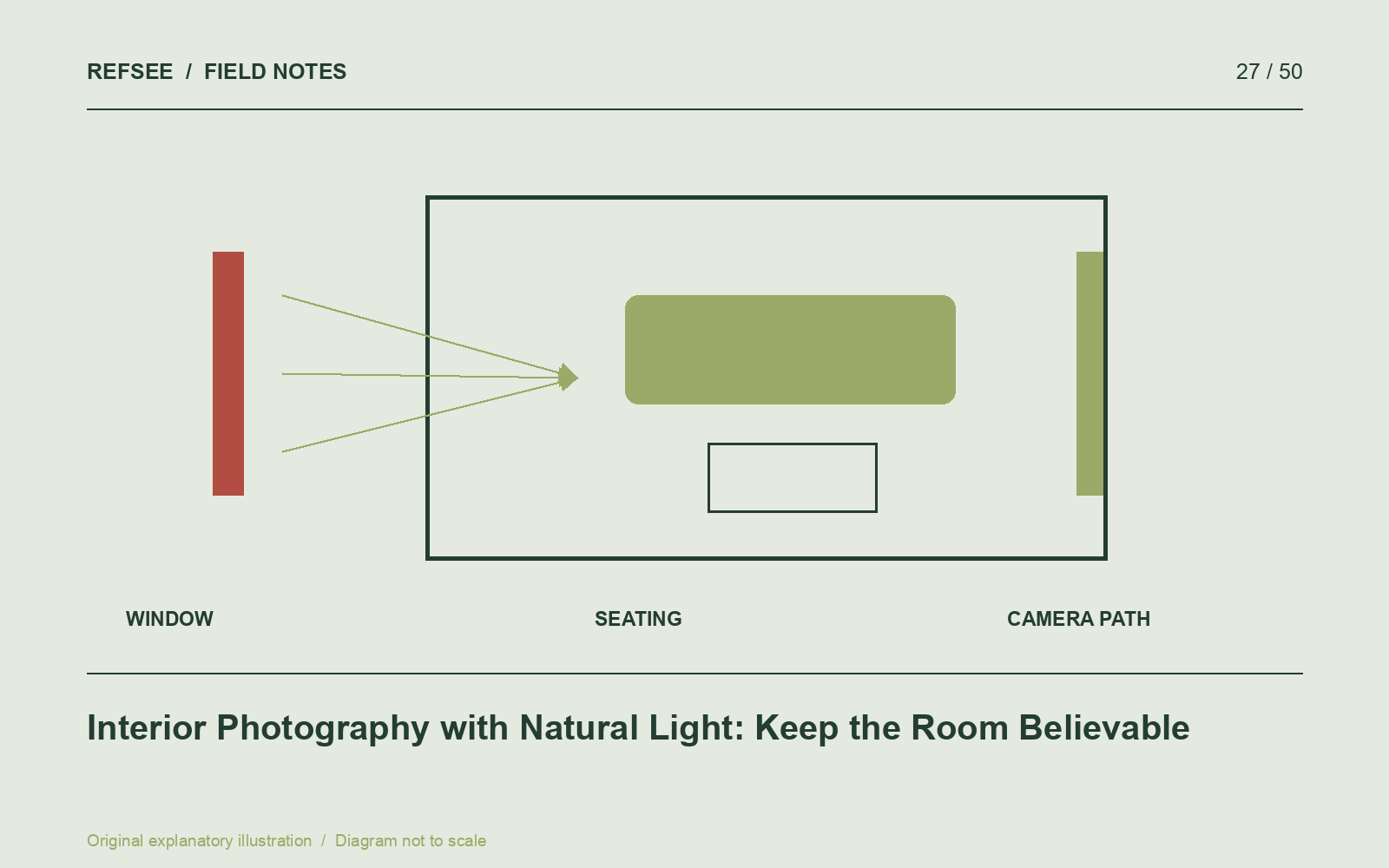
Find the room's strongest relationship
Choose a view that connects important elements, such as a window and reading chair or a kitchen island and dining area. Move the camera until furniture separates cleanly. A chair overlapping a table leg may be harmless in person and confusing in a photograph.
Keep the camera at a height appropriate to the room and its surfaces. Too high can expose excessive tabletop area; too low can make furniture block the architecture. Use a level camera when parallel verticals are part of the intended presentation.
Avoid the widest possible view by default
An extremely wide view can exaggerate foreground furniture and stretch the edges. Step back or choose a slightly narrower field of view when the room allows it. If one image cannot explain the space without distortion, make two complementary images.
Check the frame edges carefully. Partial lamps, clipped chair backs and narrow door fragments often feel accidental. A deliberate crop is better than an almost-complete object pressed against the border.
Balance the window and the room
Decide whether the view outside is essential. If it is, plan exposure or a controlled combination of captures that preserves it. If it is not, a brighter window may be acceptable as long as it supports the room's atmosphere.
When blending exposures, preserve believable light direction and contrast. Making every corner equally bright can erase the sense of depth. Keep the camera stable and watch moving curtains, foliage and changing sunlight between frames.
Simplify color and styling
Test practical lamps with and without daylight. Warm lamps can belong naturally in the scene, but unwanted mixed casts may make neutral surfaces difficult to render. Choose a consistent interpretation rather than neutralizing every surface independently.
Style the room as a plausible space people use. Straighten obvious distractions, but leave meaningful objects that explain scale and function. End with a wide view, a connecting view and a detail so the finished series conveys both layout and atmosphere.