Journal
Automotive Photography: Choose the Location for Its Reflections
Improve car photography by reading body reflections, selecting camera height and planning a controlled location before chasing dramatic backgrounds.
Refsee ·
A car is a large reflective sculpture. Its paint records the sky, buildings, trees and photographer, so the environment is part of the lighting setup. A striking location can still produce messy reflections that hide the body shape. Scout for what the car will reflect as carefully as for what appears behind it.
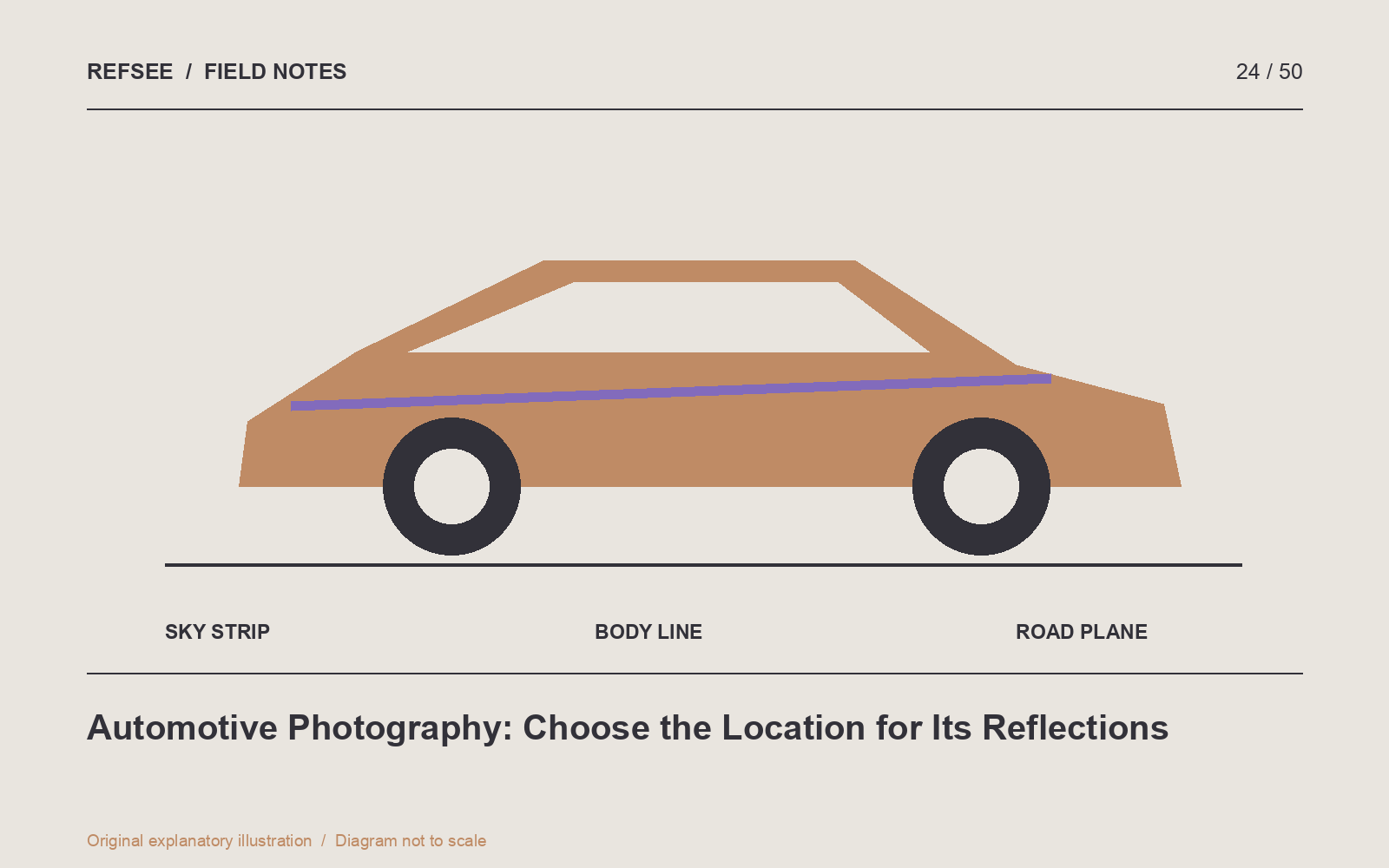
Read the major body surfaces
Look at the hood, doors, roof and front quarter panel separately. Each faces a different part of the environment. A broad bright sky can create a clean highlight, while broken trees may produce a pattern that makes a smooth panel look uneven.
Walk around the parked vehicle and watch the reflections travel. Small rotations can move a distracting building edge away from a badge or body crease. Photograph a reference at each useful position before changing the car's orientation.
Choose height for the design
A low camera can emphasize stance and make the vehicle feel substantial. A higher position can reveal the hood and roof more clearly. Neither is always better. Match the viewpoint to the feature you want the image to communicate.
Check wheel alignment and the visible side of the tires. A slight steering adjustment can improve the front wheel's relationship to the camera, but exaggerated steering may distract from the body. Keep the intended use of the image in mind: editorial atmosphere and product description have different priorities.
Control the environment before post-production
Remove small visual distractions when permitted and choose a frame that avoids poles or bright signs emerging from the roofline. A polarizer may reduce some reflections, depending on angle and surface, but it will not remove every reflection from every panel at once.
Compare polarized and unpolarized versions. Reflections communicate curvature; removing too much can make the paint look flat. Watch for uneven changes across glass and bodywork.
Plan movement as a separate production
Begin with parked shots in an authorized, controlled location. Moving-car imagery requires a plan appropriate to the method, crew and location. Do not improvise a camera position or distract a driver in order to copy a reference frame.
For the final edit, keep color, wheel details, badges and panel proportions accurate. The strongest automotive photograph makes the design easy to read while allowing the setting and light to give that design a distinctive character.