Journal
Location Scouting: Check the Light, Sound and Working Space
Scout a filming location beyond its appearance: track daylight, listen for noise, test camera positions and document access and practical constraints.
Refsee ·
A location can look perfect in a photograph and still be difficult to film. The room may face the wrong direction, the refrigerator may interrupt dialogue, or there may be nowhere to place a camera for the reverse angle. A useful scout tests how the location behaves over time, not just how it looks when you arrive.
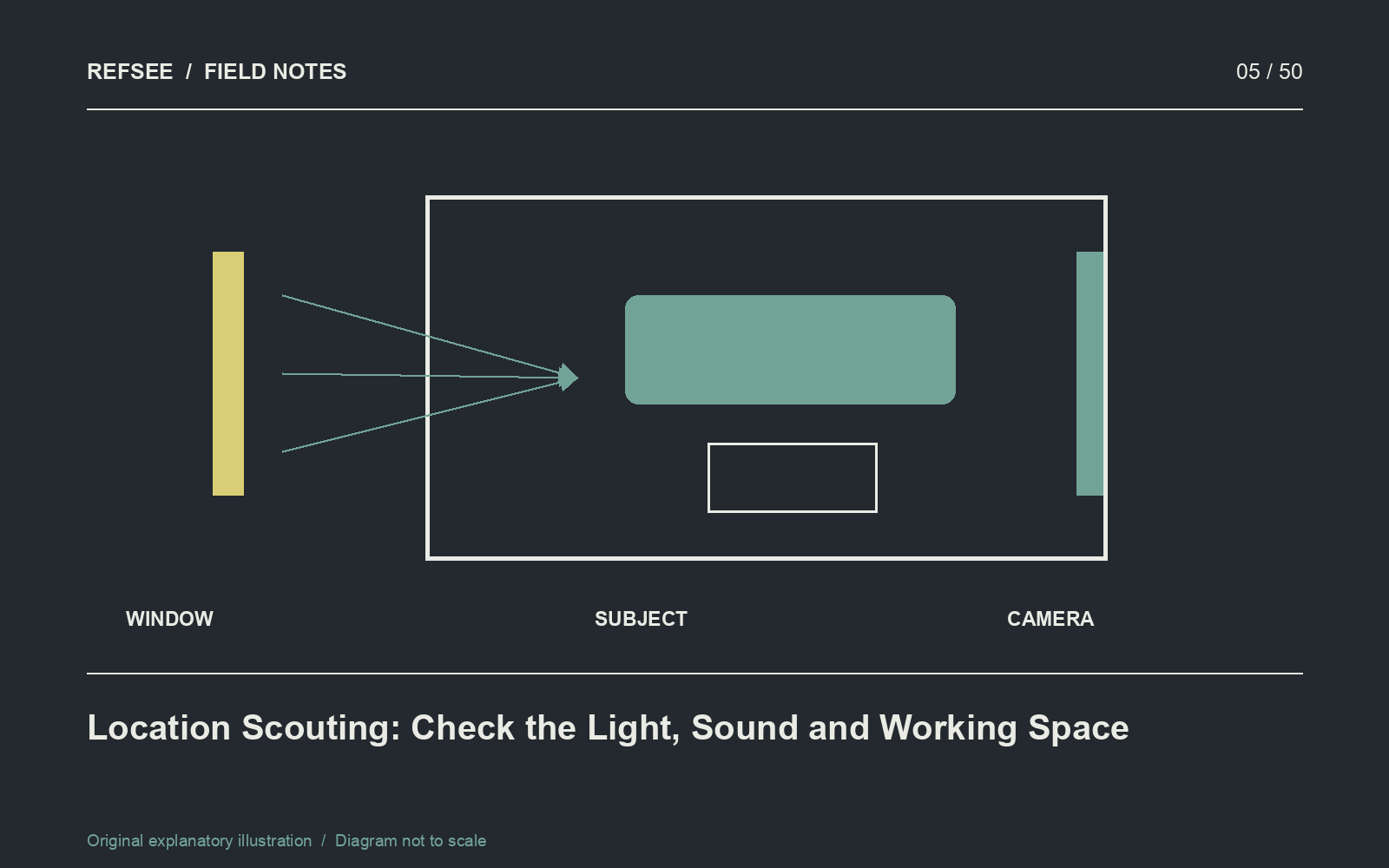
Visit at the intended shooting time
Record the date, time and weather with your photographs. Window light changes direction and character during the day, and seasonal differences can matter. A bright room on an overcast morning does not guarantee the same exposure on a sunny afternoon.
Photograph toward and away from the windows. Note which surfaces bounce light and where direct sun lands. If the story requires consistency across several hours, consider whether the windows can be controlled and discuss that plan with the location contact.
Listen before you talk
Stand quietly for a few minutes in each filming position. Listen for traffic, ventilation, elevators, neighboring businesses and periodic machinery. Record a short audio sample at the planned microphone position, not just from the middle of the room.
Ask which noise sources can actually be interrupted and who controls them. Do not assume a building system can be switched off because it has a visible switch. Schedule-sensitive noise can sometimes be managed by changing the order of scenes.
Walk the shots
Use a phone or viewfinder to test the widest and tightest angles. Check the space behind the camera, the path of a moving operator and the distance available between subject and background. Photograph mirrors and reflective walls from the proposed lens positions.
Look for a holding area, equipment storage, restrooms, loading access and a place to conduct quiet production conversations. Confirm access hours, capacity, filming permission and any restrictions on furniture, fixtures or wall attachments with the responsible person.
Turn observations into a decision
Create a short scout report with a floor plan, labeled photos, sound notes and unresolved questions. Distinguish “observed” from “assumed.” For example: “Outlet visible beside door; available circuit capacity not confirmed.” Route electrical planning through a qualified crew member.
Compare locations against the same scene requirements. An ordinary-looking room with controllable sound and useful depth can be a stronger choice than a spectacular room that prevents the coverage your film needs.