Journal
Black-and-White Cinematography: Think in Tonal Separation
Plan black-and-white images around luminance, texture and light direction so faces, wardrobe and backgrounds remain distinct without color cues.
Refsee ·
Black-and-white cinematography removes hue as a primary way of separating objects. A red jacket and a green wall may look clearly different in color yet become similar gray values. The design challenge is to organize brightness, texture and shape so the frame remains readable after color is removed.
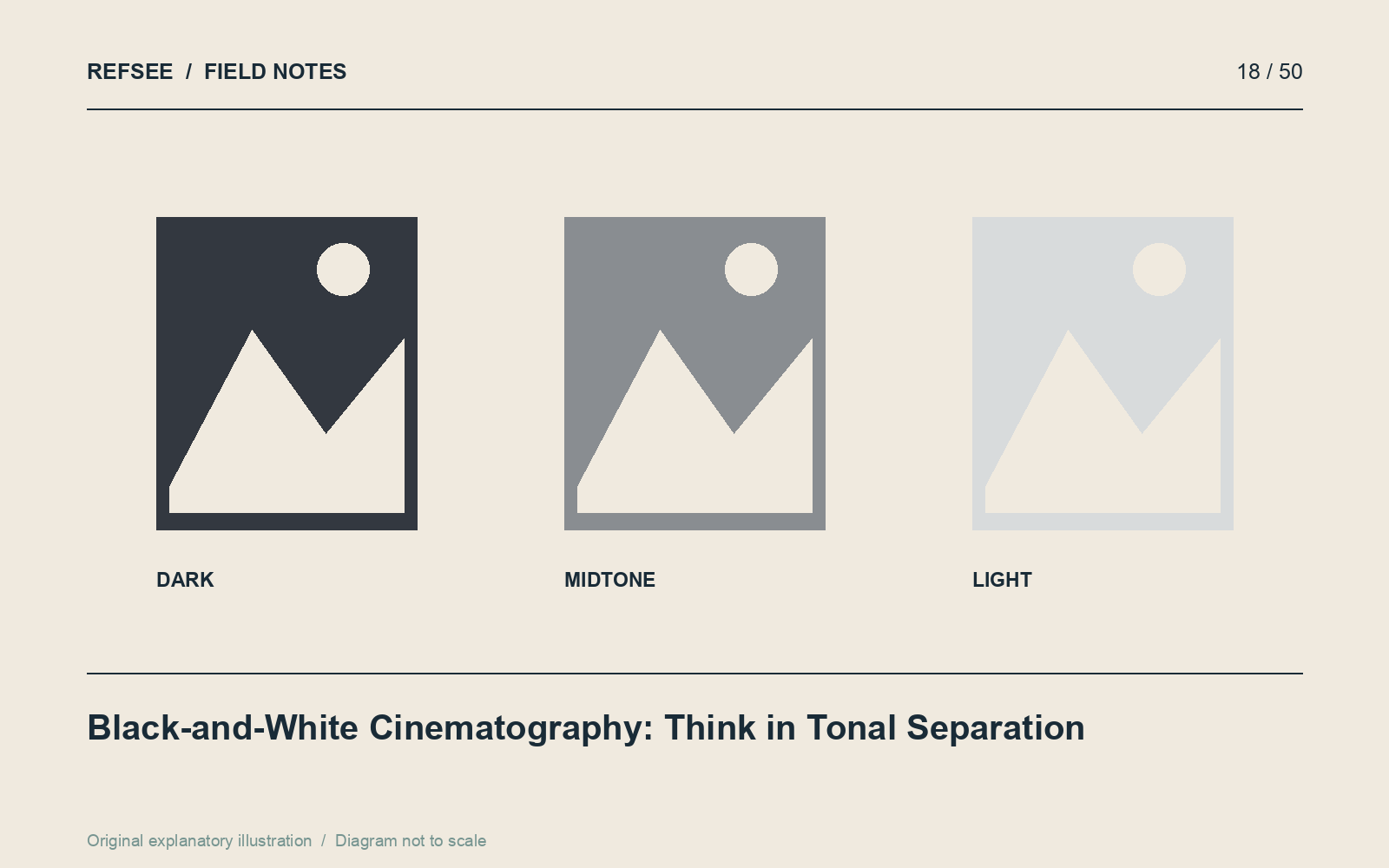
Preview the actual monochrome interpretation
Use a monochrome monitoring preview or a representative conversion during tests. Different channel mixes can produce different gray relationships, so a generic desaturation is not always the final look. Discuss the intended conversion with the colorist when the project allows it.
Compare wardrobe and background together. A costume that looked perfect on a rack may disappear into the location. Adjust material, value, light or position before assuming the grade will separate everything later.
Build a hierarchy of values
Choose the brightest important region, the main midtone area and the deepest useful shadow. These do not need to occupy equal amounts of the image. A small illuminated face inside a dark frame can carry more emphasis than a uniformly bright scene.
Check what happens at thumbnail size. If the subject vanishes, look for a stronger value difference around its outline. A background change can be subtler and more natural than adding a conspicuous edge light.
Let texture carry information
Fabric, skin, stone, smoke and wet surfaces can become especially expressive in monochrome. Side light often reveals surface changes that frontal light suppresses. Choose which textures should be visible and which should recede.
Do not confuse “black and white” with “maximum contrast.” Soft gray transitions can be central to a gentle or observational film. Deep blacks and clipped whites are stylistic choices, not mandatory ingredients.
Test a moving scene
A still image may have excellent separation while a moving actor crosses into a background of the same value. Rehearse the full path and watch the silhouette at each point. Adjust blocking or light transitions where the subject becomes unintentionally lost.
Keep color originals when they are part of your recording workflow and retain a reference grade alongside them. Document the intended contrast and important tonal relationships. That gives post-production a clear destination while preserving room to refine how different colors translate into the final monochrome image.