Journal
Symmetry in Film Composition: Order, Tension and the Break
Use symmetrical composition to establish order, direct attention and make small changes meaningful, then decide when an off-center frame works better.
Refsee ·
Symmetrical composition arranges the frame around a visible or implied axis. It can make a room feel orderly, ceremonial, confined or strangely artificial. The emotional effect comes from what occupies that order and how the scene behaves within it, not from symmetry alone.
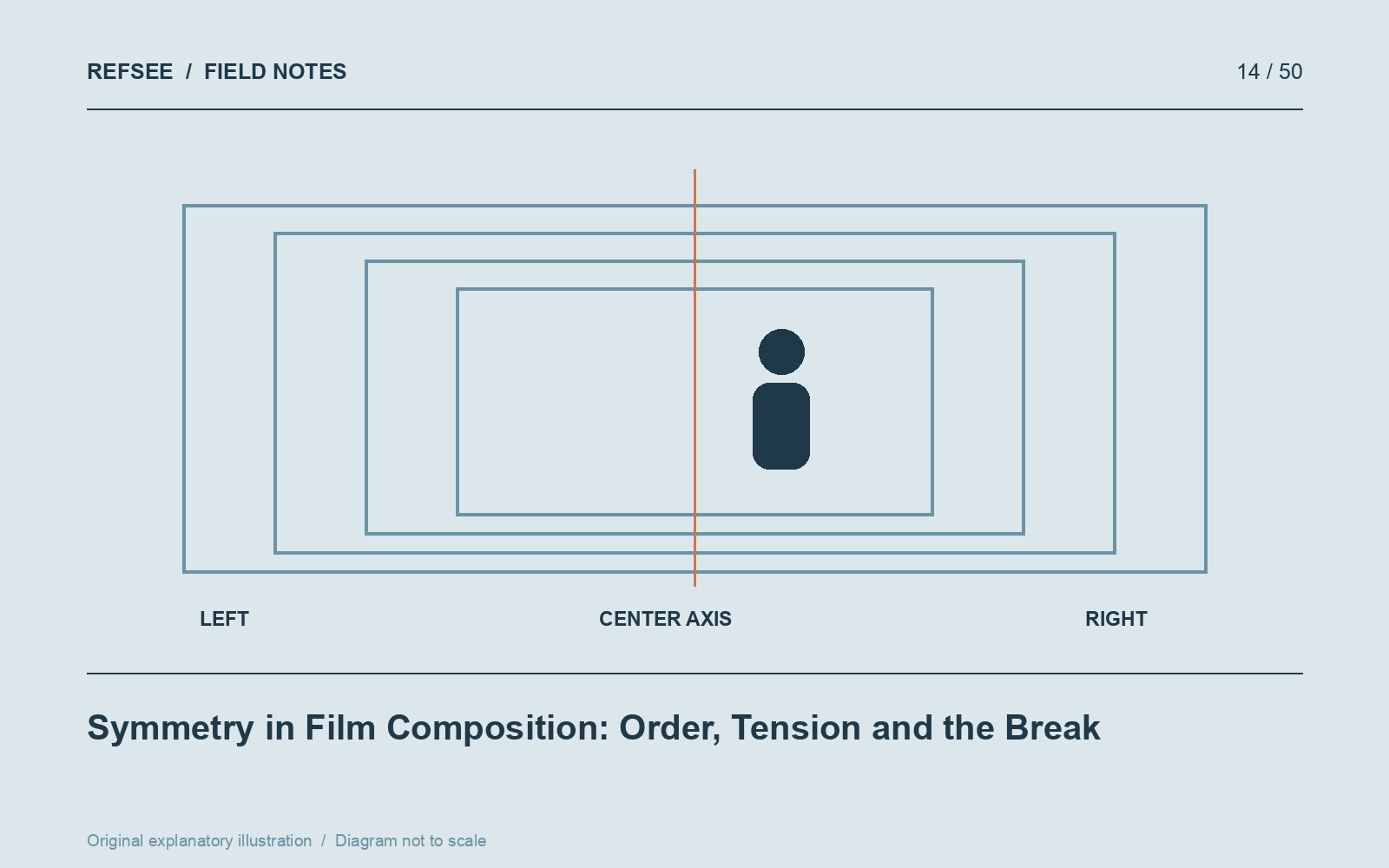
Find the real axis
Start with architecture: a doorway, corridor, table or window arrangement. Position the camera carefully and check vertical lines. A frame that is almost symmetrical can feel accidentally misaligned if the intention is otherwise very controlled.
Camera height matters as much as left-right position. A high viewpoint may expose an uneven floor pattern or tabletop; a low viewpoint may emphasize ceiling geometry. Choose the level that reinforces the important axis without distorting the room unnecessarily.
Decide what belongs in the center
Centering a character gives them a strong relationship to the frame. It can suggest authority, vulnerability or display, depending on scale and context. A small person in a large symmetrical room may feel less powerful than a large person filling the same center.
You can also leave the center empty. Two people placed on opposite sides of a table may make the space between them the subject of the shot. That emptiness becomes especially useful if someone later crosses it.
Make the break meaningful
Once the viewer recognizes a pattern, a small departure becomes noticeable. A character leaning away, a door opening on one side or an object disappearing can disturb a previously stable image. Hold the frame long enough for the original order to register before changing it.
Avoid breaking symmetry just because a centered shot feels static. First ask whether movement within the frame, performance or sound already creates tension. A locked frame can be active when the relationships inside it change.
Compare against an asymmetric version
Shoot or sketch the same action with the subject displaced from the center. Does the scene become more observational, more directional or simply less clear? Choose the arrangement that supports the dramatic relationship.
When collecting symmetrical references, annotate the mechanism: axis, scale, repetition, empty center or deliberate disruption. This helps you borrow a compositional idea without recreating a recognizable set design or assuming that every centered image carries the same meaning.