Journal
Brand Moodboards: Turn Visual References into a Distinct Identity
Create a brand moodboard that connects audience, photography, typography and materials, with clear selection rules and useful design boundaries.
Refsee ·
A brand moodboard is an early visual argument about how an organization should appear and feel. It is useful before a full identity system exists because it lets a team compare directions quickly. Its weakness is that attractive references can create agreement without revealing whether everyone is agreeing to the same thing.
Translate strategy into visible behavior
Start with the audience, the product and a few meaningful brand qualities. Then turn each quality into an observable choice. “Approachable” might mean eye-level photography and plain language. “Precise” might mean careful alignment and close material detail. Neither word specifies a color by itself.
Avoid using competitors as the entire reference pool. Look at architecture, editorial layouts, objects, packaging and photography that express relevant qualities through different means. This broadens the visual vocabulary without abandoning the brief.
Build coherent directions
If presenting multiple options, give each one a distinct principle rather than changing only the palette. One direction could be observational and human; another could be systematic and object-focused. Each should still solve the same strategic problem.
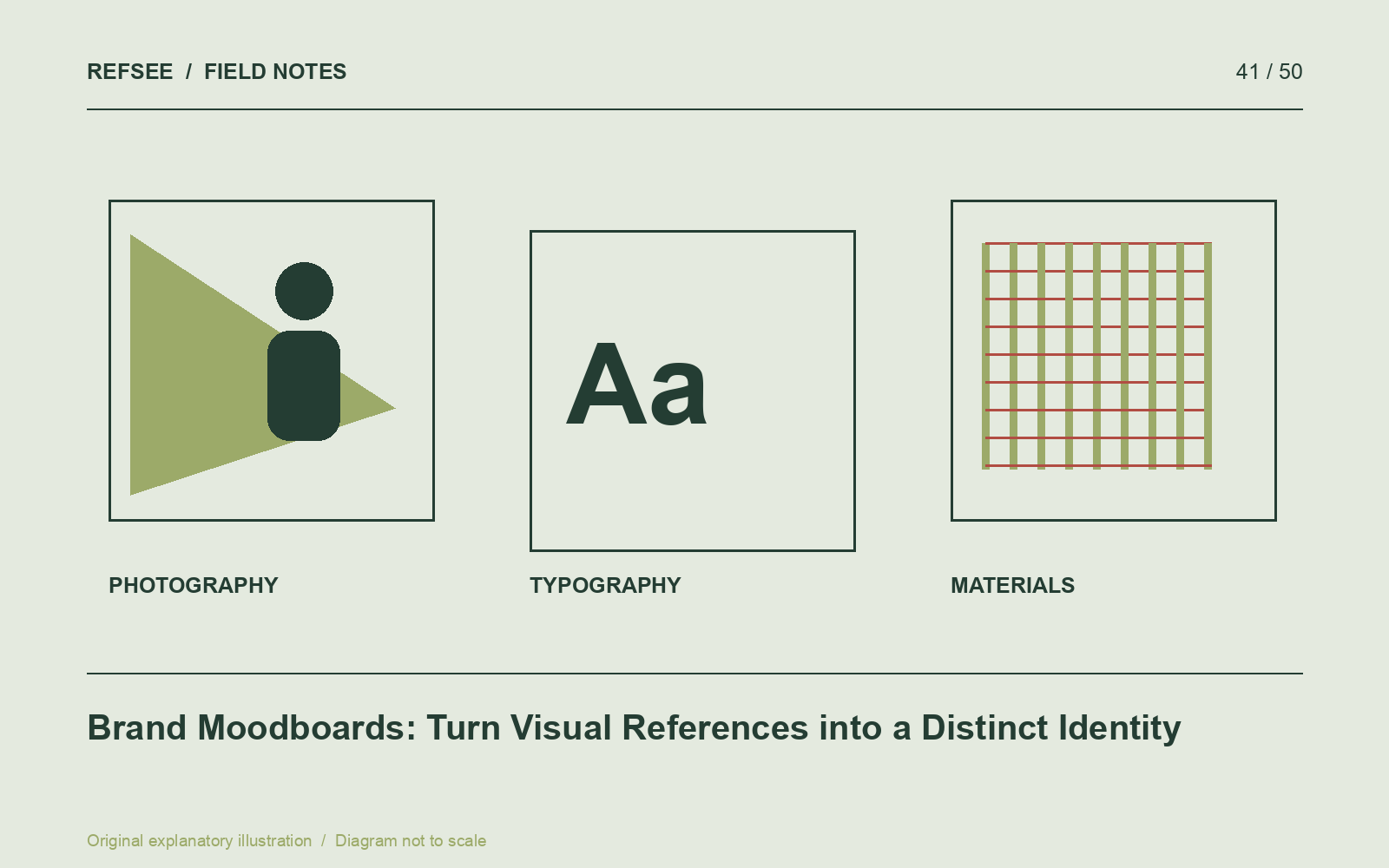
Within a direction, include photography, type character, color relationships and material or layout cues. Explain the role of each reference. A photograph may be included for its distance from the subject, not its exact subject matter.
Add boundaries that prevent drift
Write what the direction welcomes and what would break it. For example: “Natural imperfections are welcome; careless alignment is not.” These boundaries are more useful than a moodboard made entirely of positive adjectives.
Check whether the references can coexist in a real application. Place a sample headline beside an image and a simple product description. If the elements fight one another, revise the direction before presenting it as a system.
Use the board as a decision tool
Ask reviewers which direction best expresses the intended positioning and why. Avoid turning the discussion into a vote on favorite pictures. Record the agreed principles and the unresolved questions.
After approval, translate the direction into original design work rather than copying distinctive layouts or assets. Keep source links for the references, and replace them with the brand's own typography, photography and components as the identity develops. The moodboard has succeeded when it makes later decisions clearer.