Journal
How to Build a Film Moodboard That Guides a Shoot
Build a useful film moodboard with references for lighting, color, framing and movement, plus notes that turn inspiration into production decisions.
Refsee ·
A film moodboard is a curated set of images that communicates how a project should feel and how that feeling will be made. Its value is not the number of beautiful pictures. Its value is whether a director, cinematographer and designer can look at it and make compatible decisions. Start with a sentence about the audience's experience: “A familiar kitchen becomes quietly unsettling.” That sentence is a better filter than “cinematic.”
Give each reference a job
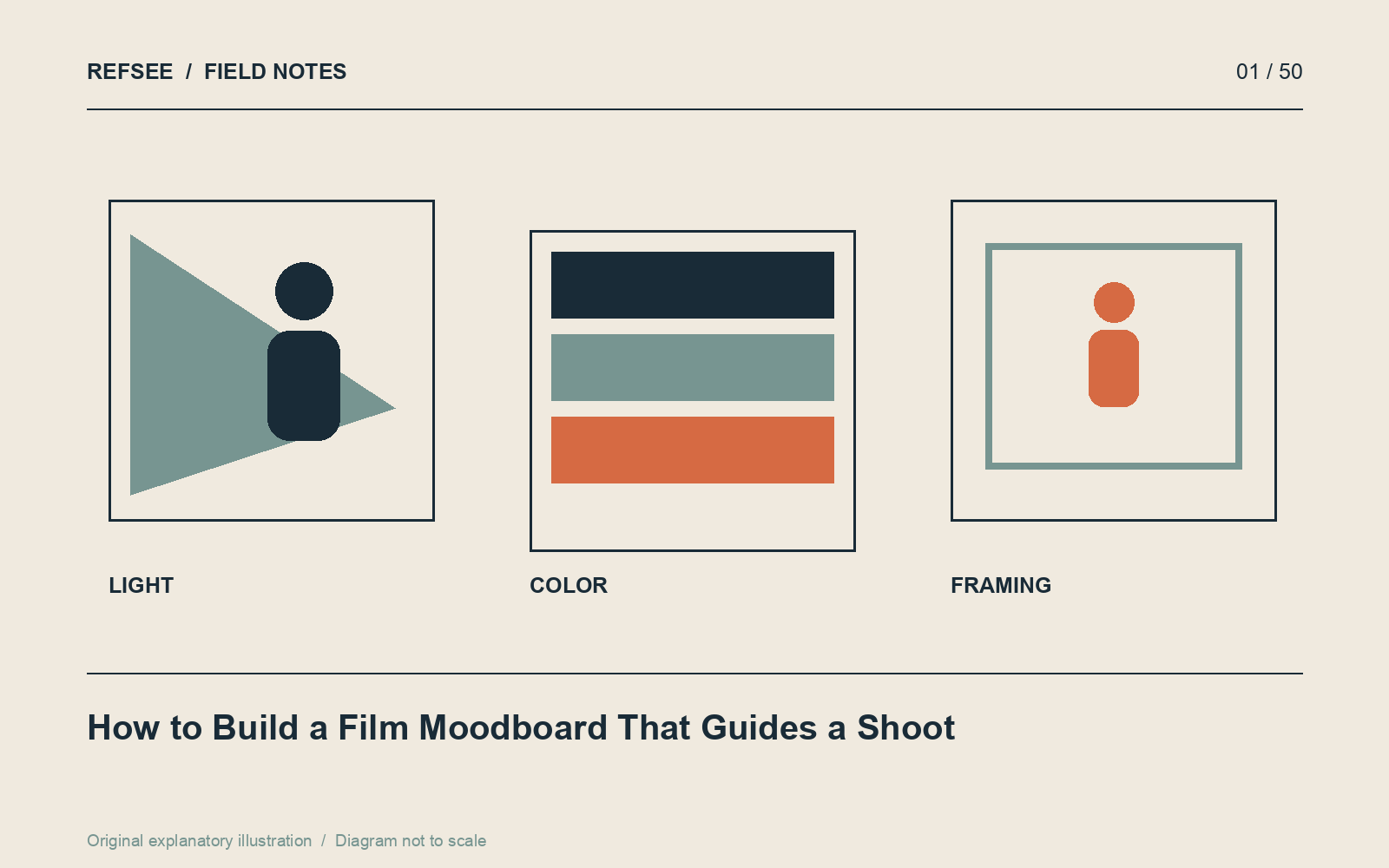
Divide the board into lighting, color, composition, production design and movement. A frame can appear in more than one category, but explain the different lessons. One kitchen photograph might demonstrate window direction; another might establish worn surfaces. Avoid asking a single image to stand in for an entire film.
Write a short annotation beneath every selection. “Keep the foreground dark so the doorway attracts attention” is actionable. “Love this vibe” leaves the important interpretation to someone else. For moving references, record a timestamp and describe what changes during the shot.
Reduce the board before presenting it
Collect broadly, then remove repetitions. If six images communicate the same cool window light, keep the clearest one and a useful variation. As a starting constraint, try twelve references across four sections. The exact count matters less than whether a viewer can understand the direction without a guided tour.
Add one boundary per section. A palette board might say, “Warm wood is welcome; orange skin is not.” A movement section could specify, “Slow human drift, no floating architectural tour.” Boundaries prevent an attractive reference from being copied in the wrong way.
Test the board against a real scene
Imagine a character entering the kitchen, finding a letter and sitting down. Can the board help the team choose a camera position, an important prop, a light direction and a background color? If not, it is still an inspiration collection rather than a working document.
Use Refsee's visual search to find alternatives for a missing decision, then group the useful results in a moodboard. Search descriptions of visible qualities, such as “single person kitchen side light,” rather than relying only on genre names.
A practical handoff
Export or share a version with the project name, date and one-paragraph intention. Keep sources attached to references. After the first test shoot, update the board with your own frames: they show how the original ambition translates to your actual location, equipment and performers.