Journal
Create Depth with Foreground, Midground and Background
Build depth in a two-dimensional frame using overlapping layers, subject distance, contrast, focus and camera movement that reveals spatial relationships.
Refsee ·
A screen is flat, but an image can still suggest a rich three-dimensional space. Depth comes from cues such as overlap, relative size, perspective, tonal separation and motion. A blurred background is one useful tool, but it is not the only way to keep a frame from feeling flat.
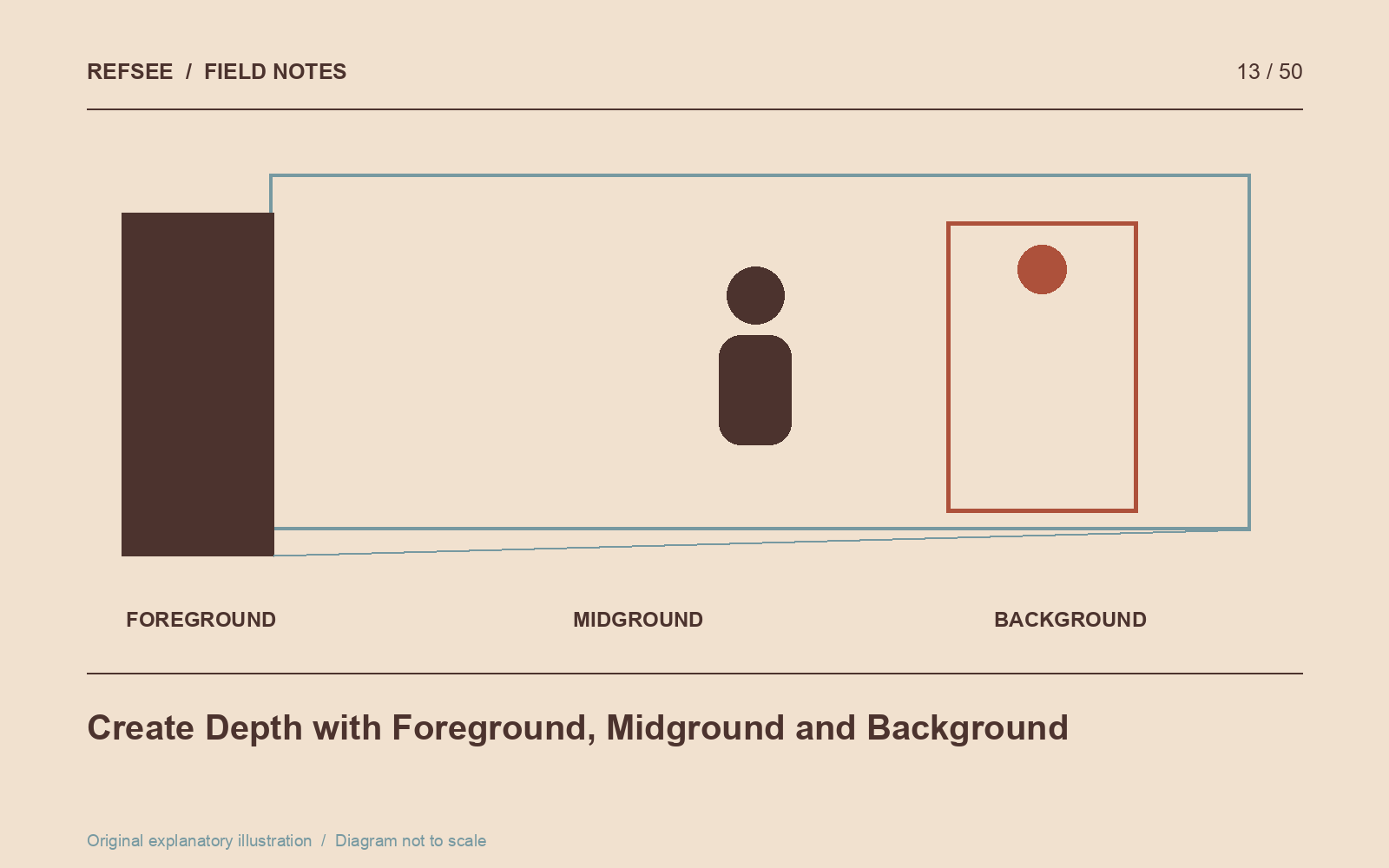
Place the subject away from the wall
When the subject stands directly against a background, the image has fewer distinct planes to work with. Moving the subject forward can create room for shadows, separate focus distances and allow light to affect the person and wall differently.
Try a position where the camera can see into the room rather than straight at its shortest wall. A diagonal view often reveals receding furniture, doorways and floor lines. Check that the added detail supports the scene rather than making the frame busy.
Use foreground with a purpose
A doorway edge, plant, shoulder or piece of equipment can establish the viewer's position in the space. Keep it meaningful. An arbitrary blurry object placed across every frame quickly feels like a decorative trick.
Adjust the size and brightness of the foreground element. If it blocks a key gesture or draws more attention than the subject, reduce its dominance. A dark edge can frame a face; a bright edge may compete with it.
Separate planes through light and color
Give adjacent layers enough difference to remain readable. A dark jacket can separate from a lighter wall, while a warm face can stand apart from a cooler background. You do not need a rim light in every scene if value, color or texture already provides separation.
Deep focus can show depth clearly when the layers are well arranged. Shallow focus can emphasize one plane, but too little recognizable background may remove the spatial information that gave the shot meaning.
Let movement reveal distance
When the camera moves sideways, nearby objects shift across the image faster than distant ones. This parallax can make space feel tangible. A small move past a doorframe may communicate more depth than a large push toward a blank wall.
Build a test frame with one foreground element, one subject and one background landmark. Make a static version and a short lateral move. Compare which cues do the work. Save the simpler version if the extra movement does not add useful information to the scene.