Journal
Sports Video Shot Planning: Show Effort, Space and Result
Plan sports footage with readable action, useful camera positions, recovery moments and detail coverage that connects effort to an outcome.
Refsee ·
Sports footage becomes a story when the viewer understands what the athlete is attempting, what makes it difficult and what happens afterward. Slow-motion highlights can show physical detail, but they do not automatically explain the event. Begin with the action's geography and the athlete's goal.
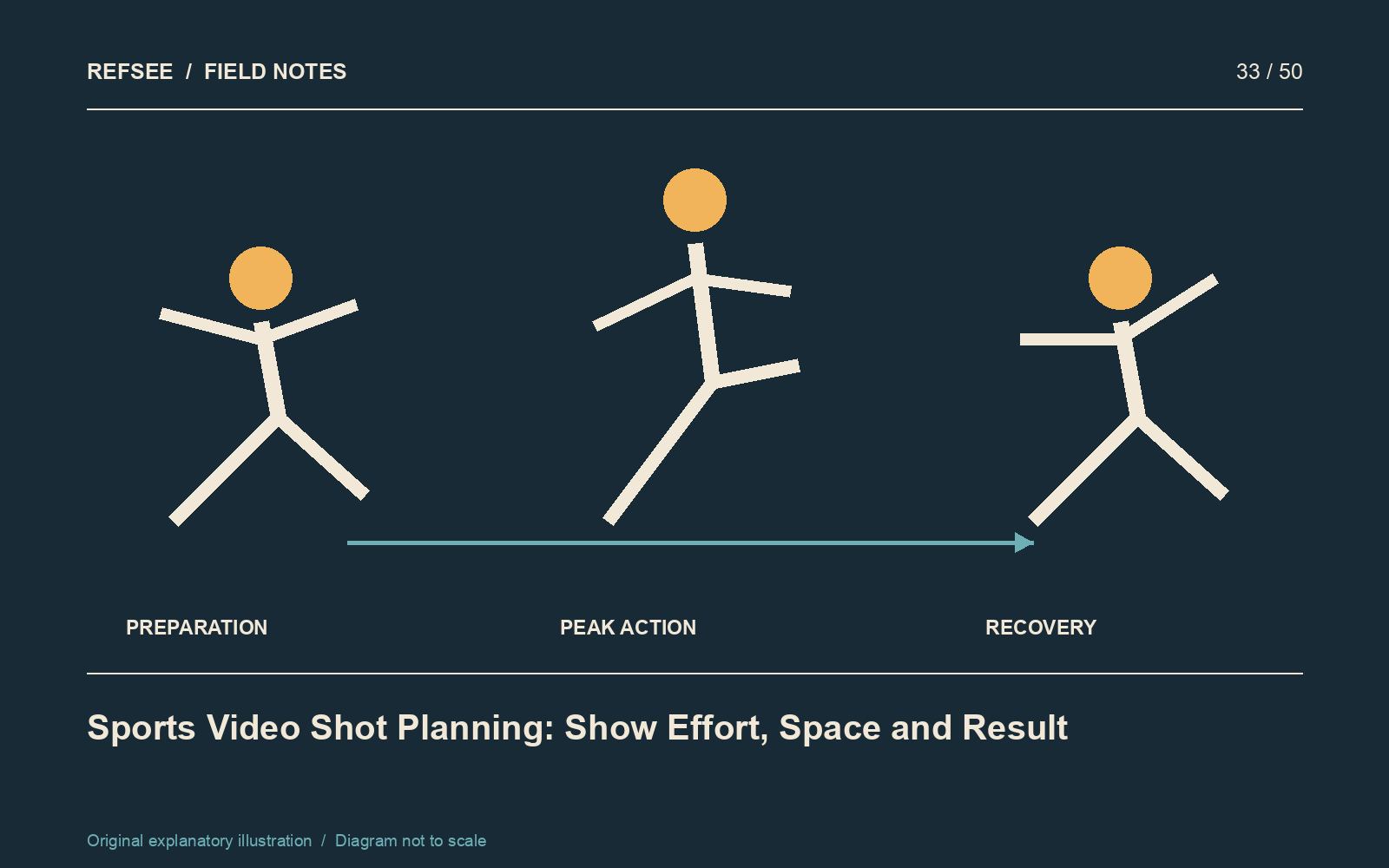
Learn the movement before choosing angles
Watch a rehearsal or ask the athlete to describe the sequence. Identify the preparation, decisive moment and recovery. For a jump, those may be the approach, takeoff and landing. Each phase suggests different coverage and different camera-position requirements.
Establish the direction of travel. A side view can explain distance, while a frontal view may emphasize effort but hide the path. Choose a primary angle that makes the action readable before adding more dramatic perspectives.
Keep filming positions outside the action path
Coordinate with the athlete, coach or event team about permitted areas and predictable movement. Use appropriate distance and lenses rather than placing an operator where a person or piece of equipment may travel. Agree how filming stops if conditions change.
For repeated performances, distinguish a real attempt from a staged pickup in your planning. Repetition can be physically demanding, so build the shot list around the athlete's capacity and the event's schedule.
Mix time scales deliberately
Normal-speed footage communicates pace and spatial difficulty. Slow motion can reveal technique, impact or expression. Use the recording frame rate and shutter choice that support the intended result, and test lighting for flicker when relevant.
Avoid presenting every moment at the same stretched speed. A real-time approach followed by a brief slowed detail can create contrast, while a return to normal speed restores the action's physical energy.
Capture what happens around the highlight
Hands preparing equipment, breathing before an attempt and the first reaction afterward can make the achievement understandable. Record useful location sound when conditions allow: footfalls, equipment contact, breath and the surrounding space.
In the edit, connect preparation to action and action to consequence. Do not imply a successful outcome using a reaction from an unrelated attempt in documentary coverage. A clear sequence with a modest number of angles can be more powerful than a reel of disconnected peak moments.