Journal
Street Photography: Build a Frame and Wait for the Moment
Practice street photography through observation, layered composition and anticipation, using a stable frame to recognize gestures and visual relationships.
Refsee ·
Street photography often looks spontaneous, but strong images can emerge from patient preparation. You notice a background, choose a camera position and wait for human activity to create a relationship inside it. This approach is especially useful when walking continuously produces many busy photographs without a clear subject.
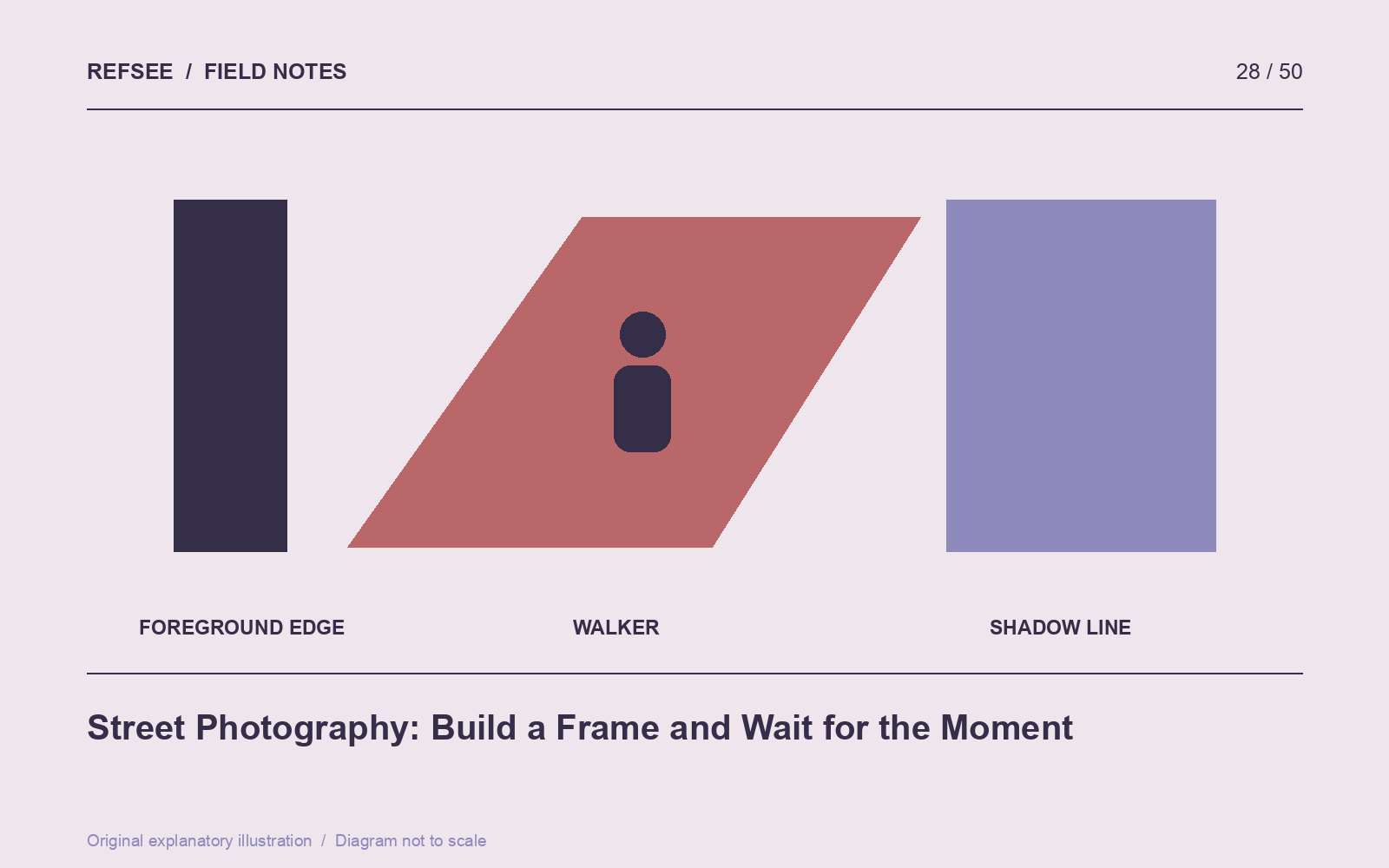
Find a stage with a visual question
Look for a patch of light, a repeated shape, a doorway or a clean background. Ask what kind of action would make the arrangement meaningful. A person crossing a shadow boundary may change the frame more than another person standing in the middle of it.
Make an empty test photograph. If the background is already cluttered or the edges are unresolved, waiting may not fix it. Move until the frame has a clear structure and enough room for the action you expect.
Watch behavior rather than only appearance
Notice rhythms: people pause at a crossing, turn toward a shop window or adjust bags before entering a station. Anticipation comes from observing those patterns. It does not require staging strangers or pressuring them to perform.
Choose camera settings that suit the likely movement and available light. Decide whether you want a sharply recorded gesture or a controlled amount of blur. Test before the moment arrives so you are not changing several settings at once.
Work with layers selectively
A foreground edge can place the viewer in the scene; a middle-distance person can carry the action; a background sign or shape can complete the relationship. More layers are not automatically better. Check whether each layer contributes to the image or simply adds visual noise.
Watch for accidental mergers around heads and hands. A small change in timing can separate a gesture from a pole or another passerby. Review sequences for those relationships instead of choosing only the sharpest frame.
Be attentive to the people in the scene
Respect local rules, private spaces and requests to stop. Consider whether the image exposes someone in a vulnerable situation and whether your intended use changes the context. A photograph can be candid without treating people as interchangeable visual props.
After the session, select a few images and write one sentence about the moment each contains. If the explanation is only “interesting person,” look harder at the composition. The strongest frame usually contains a specific relationship between gesture, space and timing.