Journal
Travel Photography: Build a Story Beyond the Landmark
Create a travel photo story with context, daily activity, details and transitions, then edit the images into a sequence rather than a collection of landmarks.
Refsee ·
A travel photo story gives the viewer a sense of place through relationships, not just recognizable sights. Landmarks can establish geography, but daily routines, materials, weather and transitions often explain how the place feels. Choose a small subject you can observe well rather than trying to summarize an entire city in one afternoon.
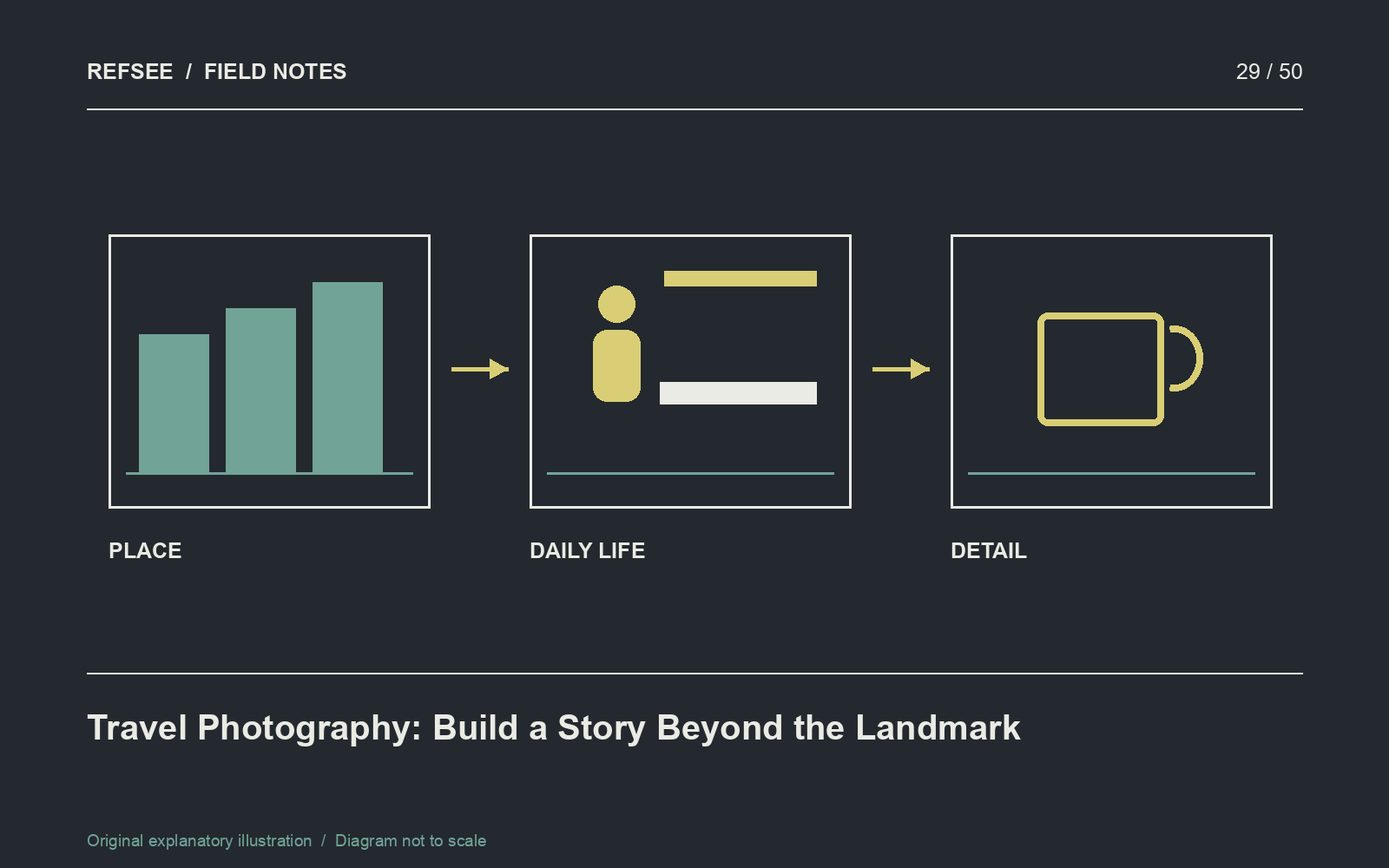
Set a manageable theme
Possible themes include a market opening, a ferry journey, a neighborhood at first light or the route between a station and the sea. A narrow theme helps you recognize relevant moments and avoid collecting disconnected attractive scenes.
Write a simple question: “How does this street wake up?” That question suggests shutters, deliveries, cleaning, breakfast and the arrival of customers. It also gives you a natural sequence.
Gather different kinds of information
Make a contextual wide image, a medium-distance action image, a detail and a transitional frame. These are roles, not a mandatory formula. If two photographs tell the same thing, keep the stronger one and look for the missing information.
Details should connect to the story. A worn ticket, a stack of cups or wet footprints can be more revealing than an unrelated close-up of a colorful wall. Include enough context that the detail does not become a generic texture study.
Let people participate appropriately
When making a considered portrait or photographing someone's work closely, communicate your intention and ask when appropriate. Do not interrupt a task simply because the light is attractive. Learn names and accurate descriptions if the images will have captions.
Keep notes while the information is fresh. Distinguish what you observed from what someone told you. Avoid turning a single encounter into a broad claim about a culture or community.
Edit for progression
Arrange a first selection without worrying about the strongest image opening the set. Look for a sequence that introduces place, develops activity and ends with a sense of completion or continuation. Alternate scale where it improves rhythm.
Remove photographs that repeat the same visual information, even if they are individually attractive. Keep color and contrast consistent enough that the sequence feels connected, while allowing genuine changes in time and weather to remain visible. A focused eight-image story can communicate more than fifty unrelated highlights.