Journal
Visual References and Copyright: A Practical Creative Workflow
Keep visual research usable with source records, clear permissions and a distinction between private inspiration, client presentations and published assets.
Refsee ·
Visual references help teams discuss composition, lighting and mood, but finding an image online does not establish permission to reuse it. The practical task is to track where an image came from, how you intend to use it and which rights or exceptions may apply. Those questions become more important as a private research board turns into a public campaign.
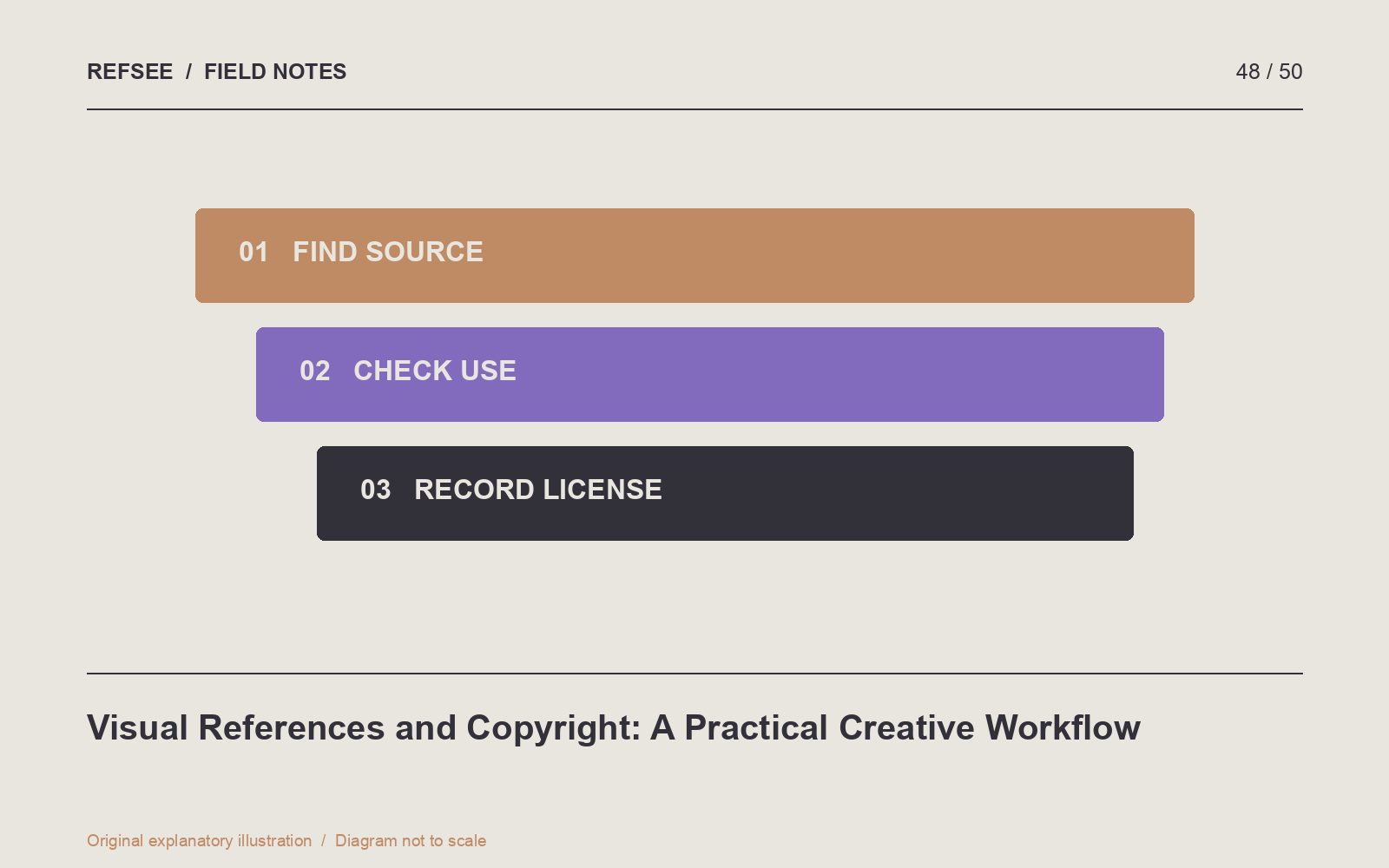
Record the source when you save the image
Keep the creator's name when known, the original page, the date accessed and any license information. A repost or search thumbnail may help you discover an image without being the best source of rights information. Follow it back where possible.
Do not guess an attribution from a visual resemblance. Mark unknown information clearly and investigate before the image becomes part of a deliverable. A source record also helps you revisit the full work rather than relying on an isolated crop.
Describe the intended use precisely
Private research, a client pitch, a published blog, advertising and a resale product are different contexts. A license that supports one use may not support another. Check the actual terms, including modification, attribution, distribution and any restrictions relevant to your project.
Credit is not automatically a substitute for permission. Likewise, an image described as “royalty-free” is not necessarily unrestricted or free of charge. Read the license attached to the specific asset.
Borrow the principle, develop original execution
Annotate the feature you are studying: soft side light, a low viewpoint, restrained color or a particular pacing idea. This helps the team translate a general technique into its own work instead of duplicating a distinctive arrangement.
When presenting references, label them as references and keep source information nearby. Replace them with commissioned, licensed or original assets as the project moves toward publication. If a reference must remain in the final work, resolve that use explicitly.
Keep an asset ledger
For published materials, record the file, source, creator, license or permission, required credit and any relevant usage limits. Store the supporting documentation with the project so someone else can understand the decision later.
Copyright exceptions and related rights vary by jurisdiction and context. For an uncertain commercial use, seek qualified advice on the specific situation. A clear ledger does not answer every legal question, but it makes the questions visible early enough to solve them without rebuilding the project at delivery.